


When we introduced spray tanning nearly 16 years ago, it created an exciting opportunity that spawned an industry—but it also created a major problem.
The first spray tanning was literally done with traditional handheld airbrushes that created great looking tans… but took WAY TOO LONG to administer. The problem was simple: airbrushes were designed to create precise artwork in a relatively small space. The idea of covering an entire body with that equipment—and doing so all day long, tan after tan, for years on end—was neither practical nor realistic.
So the spray tanning industry looked for a way to apply a tan FAST with a reasonable amount of precision. Various types of machines were tested—everything from modified “power painters,” to large compressed air tanks, to “reverse vacuum” cleaner engines (where the nozzle is placed on the blower side instead of the intake side).
The Results, Unfortunately, Were (And Remain) Ugly:
The “reverse vacuum” motors, also known as turbines, have become the industry standard. Turbines were originally designed for applying paint to wooden furniture, doors, and fences and not for spray tanning people. These machines are loud and hot; they create a ton of wasted overspray, deliver a crude-looking tan devoid of artistic detail, and wear out, burn out, and die prematurely. This includes the TOP brands in the marketplace—Infinity Sun, Evolv Sunless, Sun FX, and Norvell. And every other major brand worldwide.


The Results Are Stunningly Superior:
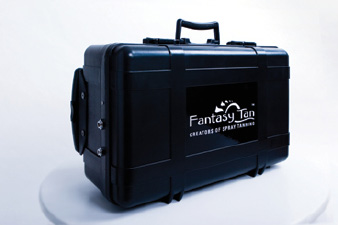
- Our unit is self-contained in a roller-board suitcase and completely portable.
- The hoses that supply the air are smaller than your pinky; the competitors, more like a garden hose.
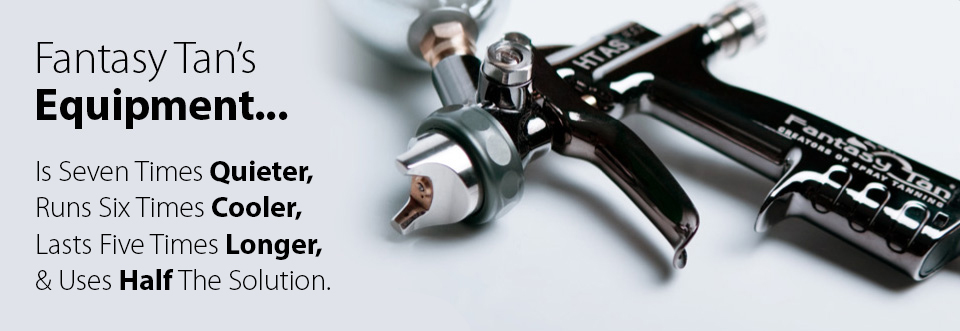
- The spray gun itself is much smaller and lighter—12.8 ounces vs. theirs at 1.5 to 2 pounds.
- Think about the above in terms of the energy needed from a technician applying 20 tans a day…
- Airbrush allows for super-realistic tans—even around hair lines, finger tips, knees, elbows, & other tricky spots.
- Modular—if you need service (rare), individual components can be sent instead of the entire unit.
- WAY QUIETER: Ours hums along at a pleasant 40 decibels; the others are in the 80 to 85 db range…
- That doesn’t sound too bad until you consider 80 decibels is actually TEN TIMES louder than 40 db…